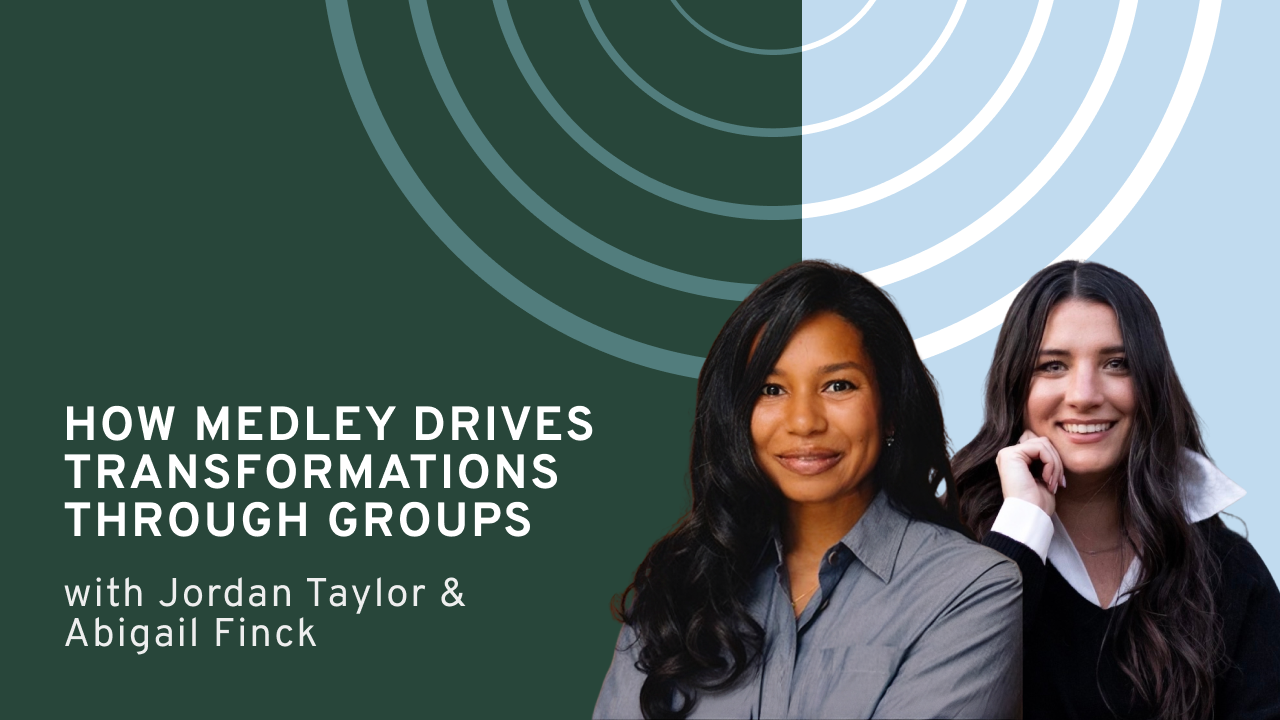
A conversation between Jordan Taylor, CEO and Co-Founder of Medley, and Abigail Finck, Head of Coaching.

In a moment when AI is transforming every industry and leaders are being asked to navigate unprecedented change, the question goes beyond “what skills do people need?” to “how can companies actually help develop them?”
In this conversation, Medley CEO Jordan Taylor and Head of Coaching Abigail Finck unpack why group coaching has become the most effective format for driving real leadership transformation, what an “AI-ready mindset” actually looks like, and how Medley is helping organizations turn disruption into an opportunity for growth.
Jordan’s path to founding Medley started with a personal realization. As someone who'd always grown the most in team environments, she found it surprisingly difficult to find that same sense of collective learning in the professional world.
The turning point came during her final semester at Harvard Business School in a course called Authentic Leadership Development. The bulk of the learning happened in small groups of six, meeting for two hours every week over a full semester. The experience was transformative: it expanded her self-awareness, deepened her understanding of others, and planted the seed that this kind of group learning could reach far more people.
After graduation, Jordan dove into research. She found that high-impact group experiences existed in executive forums, addiction recovery programs, and religious communities, but rarely in the broader leadership development space. When her mother, Edith Cooper, was coming off a 30-year career in financial services, including a decade as a senior executive at Goldman Sachs, she saw the need from an organizational perspective. Together, they founded Medley and have spent the past seven years building and refining the model.
Strategically integrating AI is more than a technological challenge, it’s a leadership challenge. Jordan is clear that organizations can offer access to AI platforms like Copilot, ChatGPT and Claude, but if people don’t want to use them, or don't recognize the importance of changing how they work, the investment falls flat.
From Abigail's perspective as a coach, an “AI-ready mindset” for leaders means being willing to honestly examine their relationship to what’s changing. In group coaching sessions, AI becomes a doorway into deeper work by allowing leaders to explore what they may be afraid of, what assumptions they may be holding onto too tight, and the degree to which they can experience disruption without judgment.
Many managers are caught in the bind of having to learn new skills while managing their own uncertainty and supporting their teams through the same transition.
Medley groups give leaders the space to process the complexity of this moment alongside peers who are navigating the same challenges.
One of the most powerful aspects of the group coaching experience, Abigail explains, is that a well-composed group functions as a microcosm for the systems leaders actually operate in. The complexity, the differing perspectives, the need to communicate and listen across differences all present themselves in the room.
That means the skills leaders practice in their Medley group like vulnerability, global listening and navigating ambiguity are highly relevant to working within their teams, their cross-functional partnerships, and their organizations. “Global listening,” as Abigail describes, is not just hearing what someone is saying, but understanding what's beneath the surface, how it connects to their own experience, and what they might have to contribute. When that practice spreads through an organization, it can create a more connected way of operating.
Medley doesn't leave group composition to chance. Jordan describes how its proprietary AI-enabled group matching algorithm balances three dimensions: organizational goals, individual growth areas, and what the science says about optimal group dynamics.
This means a cohort of 500 leaders can be matched in a matter of hours, with each group optimized for the right blend of social cohesion (do people connect well?) and task cohesion (is the learning productive?). Medley groups always bring together people who don't work together day to day, which enables new relationships and perspectives to form. And the data consistently shows that the strongest groups share overlapping growth areas while bringing diverse styles and viewpoints to the conversation.
For an in-depth explanation of Medley’s research-based approach for creating optimal groups for growth, see our article “Medley’s Proven Approach to Leadership Development in the Age of AI”
Jordan calls it a hot take: group coaching can actually be more effective than one-on-one coaching for building self-awareness, interpersonal skills, and expanded perspective.
Her reasoning is straightforward. In one-on-one coaching, you have a two-way mirror between the coach and the client. In group coaching, that mirror becomes eight-way. Each participant sees themself from eight different perspectives, learning about their blind spots, and watching how other people navigate challenges in real time.
Abigail compares it to a gym for leadership. Group coaching becomes a space to get real reps in in an environment that’s psychologically safe, but challenging enough to push genuine growth. Leaders can practice skills they might be afraid to with their actual teams then the stakes around reputation and performance are high.
Looking ahead, Jordan sees Medley’s most impactful work at the intersection of organizational transformation and leadership development. When a company is restructuring, rolling out a new strategy, or fundamentally rethinking its operating model, there’s a critical need to help leaders at every level adapt.
Medley’s approach is to go deep by partnering with organizations to design comprehensive, multi-year programs that cascade insights from senior leadership through every layer of the organization. That might include group coaching, one-on-one coaching, peer coaching, and workshops, all of which are designed around the specific outcomes the organization has identified as most important.
Group coaching at this scale provides the infrastructure for how organizations build the cohesion, adaptability, and human capability they need to thrive through a period of relentless change.
Interested in exploring what Medley can do for your organization? Reach out directly through the Medley website or connect with Jordan on LinkedIn. We'd love to learn about what you're solving for heading into 2026.